If I Ever Get Dementia, Show Me My YouTube Channel

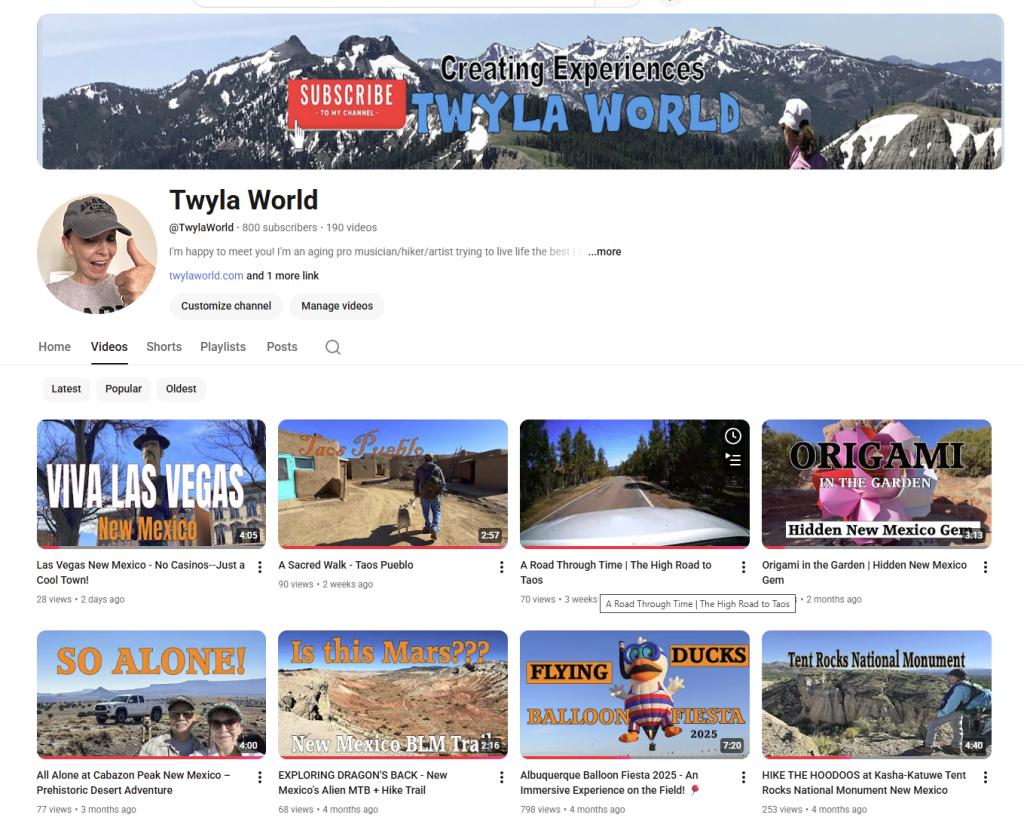
Today I Hit 800 Subscribers

(After Launching My Channel in 2006) Twenty freakin’ years!

Not 8000, Not 80,000,
Eight hundred. Yeah, you read that right! 800 and teetering…

Fun Fact: Only 10 % of YouTube Channels reach 1000 subscribers. I’m in good company with the other 90%.

My very first video 20 years ago was a grainy, low-resolution clip of my sister shadow dancing at Burning Man. (since removed) I edited it in Windows Movie Maker. Digital cameras were still evolving, and the videos were Blurry. Tiny. Imperfect.

But that didn’t stop me. I continued to film and upload.

Back then, nobody really knew what YouTube was supposed to be. It was the Wild West. People posted funny skits, awkward home movies, random moments of life. No strategy. No branding. No algorithms to decode. Just curiosity and creativity.

Then came the how-to videos. Those were gold!

I remodeled parts of my house using YouTube tutorials. Total strangers taught me things I might never have learned otherwise. That was the magic — people sharing what they knew.

When I started uploading my trick riding videos, I picked up a couple hundred subscribers fairly quickly. For a minute, it felt like momentum.

Then YouTube introduced ad revenue.

I made pennies….literal pennies.

And then they changed the rules — you needed 1,000 subscribers and thousands of watch hours to qualify for monetization. That’s when my growth slowed to a crawl.

I didn’t have a niche.
I didn’t have a strategy.
I just wanted to share my crazy life in an artful way.

I’m a musician.
A hiker.
A traveler.
A ranch owner.
An artist.
A complete jackie-of-all-trades.

Over time, my equipment improved. My editing improved. I spent hours polishing videos into little documentaries of my adventures.

And sometimes they were full-blown documentaries.

I once flew to Kansas to stay with a family living in the middle of wheat fields as far as the eye could see. I filmed their simple life as farmers and the one-room schoolhouses they were restoring. I submitted that film to festivals.

Some of my videos have over 100,000 views.
Others have 25.

My subscriber count? It creeps.

I gain a few.
I lose a few.
I gain a couple more.
It inches forward.

It’s always teetering!

One day I’ll hit 1,000 subscribers. Or maybe I won’t.

But here’s what I’ve realized: That number isn’t the point.

The point is that I’ve documented my life.

When I go back and watch videos from ten or fifteen years ago, I smile. I remember who I was. What I cared about. What my voice sounded like. The light in my eyes. The people who were still here.

YouTube became my time capsule.

If I ever get dementia, I hope someone sits me down and presses play.

“Look,” they’ll say.
“This was you.”

And I’ll get to meet myself all over again.

800 subscribers – still filming.

Go take a look and don’t forget to SUBSCRIBE! I want to get to 801!
Las Vegas New Mexico. No Slots Here!

On this weeks adventure, we took a day trip to Las Vegas New Mexico. It’s about an hour and 45 minutes from our house and the scenery along the way was amazing! The landscape in New Mexico changes so dramatically around every turn in the road!

We also took a last minute 13 mile detour to check out a state park. We are so glad we did. The ancient towns we saw along the way was a trip through time and completely caught us by surprise! Sometimes these little last minute detours are sooo worth it. The road travels along the Pecos river and was once part of the Santa Fe trail. The Pecos River is 960 miles long and the camp grounds at the park are right on the river. We made our reservations go to camping there in May! Stay tuned for that video!

Tragedy at Frog Lake – Avalanche (My Thoughts)

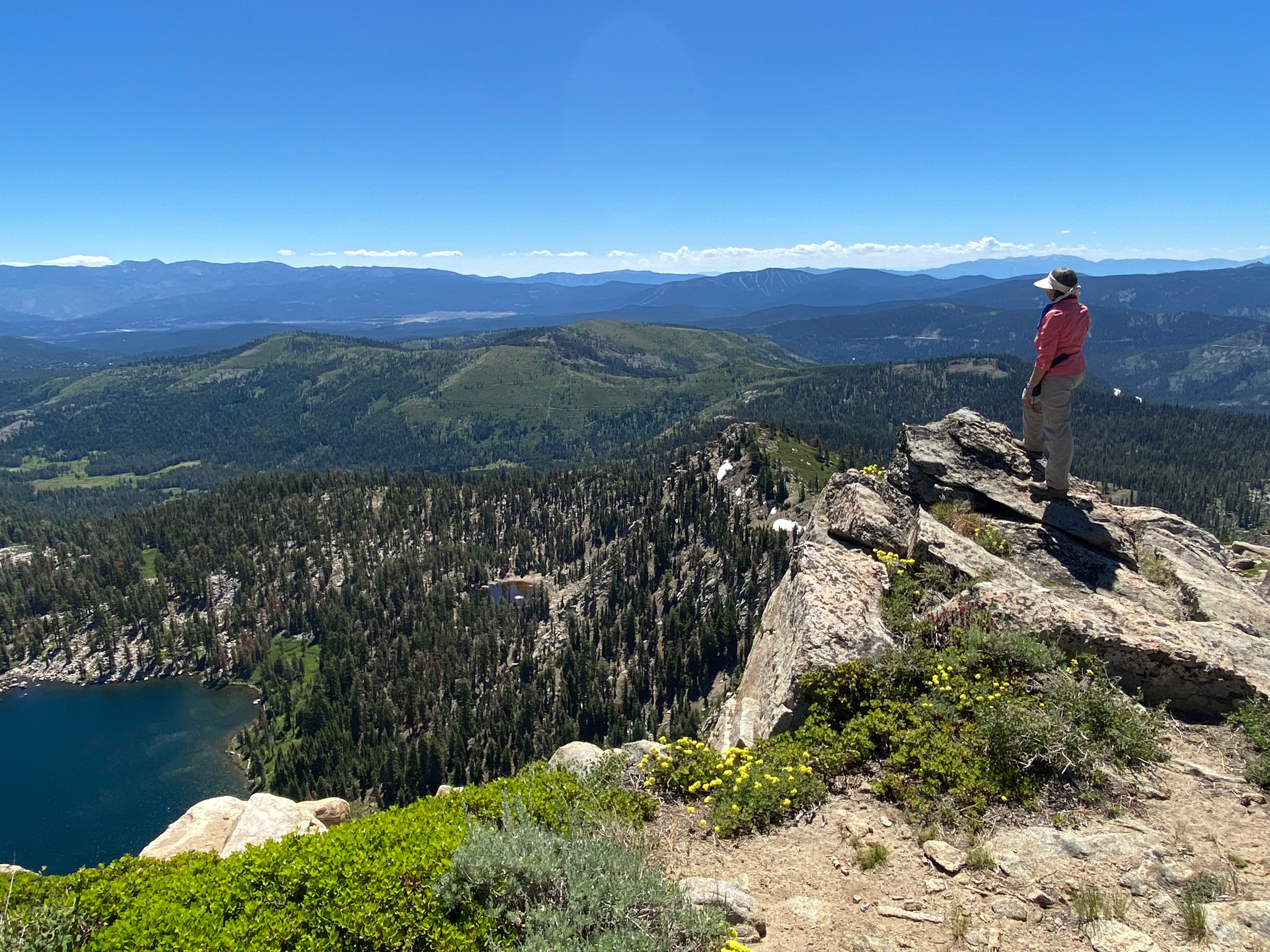
Me on Frog Lake Overlook.

When the Mountain Says No: A Memory of Frog Lake

I still remember the first time I hiked toward Frog Lake Overlook in the Sierra of Northern California.

It was summer. Blue sky. Warm sun. Wildflowers scattered along the trail like confetti. And even then — even in perfect weather — it wasn’t easy. The trail climbed steadily, the air thinned, and the slopes around felt big and exposed. It was hot, and I got overheated. At one point I honestly didn’t think I’d make it to the top, but I pushed forward.

I stopped more than once, hands on my hips, catching my breath and looking up at those towering ridgelines, thinking: This place is beautiful… but it’s serious. No joke.

In winter, that same beauty becomes something entirely different. Those open slopes fill with deep snow. Terrain that feels challenging in July turns avalanche-prone and unforgiving. It’s why the area is beloved by experienced backcountry skiers — and why it demands careful judgment every single time.

This week, that place took nine lives.

And I can’t stop thinking about how easily excitement, planning, and commitment can blur the most important decision we ever make outdoors: whether to go at all.

My husband was a private pilot for many years, and aviation teaches this lesson brutally and early. There’s a phrase pilots use: “get-there-itis.”

You plan the trip. Check the weather — all good. Drive to the airport. Then conditions change. You see holes in the clouds and start wondering: Can I get above this? Will it clear… or close in?

We’ve waited it out. We’ve diverted. We’ve cancelled entirely and driven home.

Because experienced pilots know something simple and hard:

The safest flight is the one you don’t take.

“Get-there-itis” kills pilots every year.

And sometimes, it shows up in the mountains too.

Forecasts had warned that the Sierra was about to be hammered with massive snowfall — feet upon feet in a very short time. Anyone familiar with the range knows what that means: unstable snowpack, hidden weak layers, and avalanche danger that escalates fast.

The Frog Lake huts are booked far in advance are NOT cheap and often more than a year out, with strict cancellation policies. That kind of reservation can quietly add pressure. After waiting that long, it’s human to feel like you have to go.

But mountains don’t honor reservations.

My perspective, from someone familiar with the area:

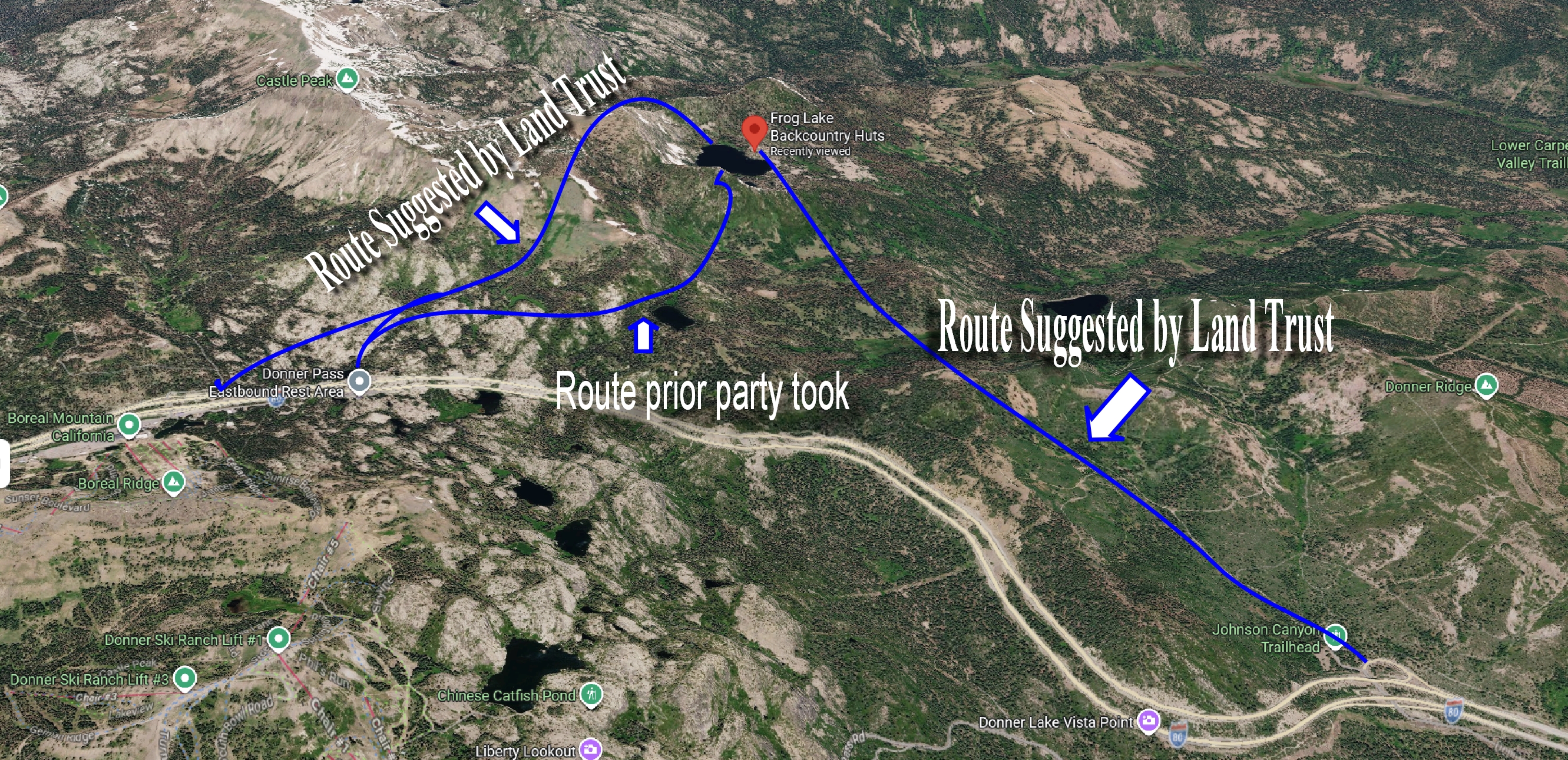
There are three routes out from the huts according to the Land Trust Website. Two of them cross the steep, avalanche-prone saddle, leading toward parking areas near I-80 and the Castle Peak trailhead — less than half a mile apart. Another option heads east along the flatter service road and heads east towards the Truckee area. Or, another option not mentioned by the Trust, is to cut over towards Summit Lake. With some backcountry navigation, that route can also be used to loop back toward the trailhead. In fact, another party reportedly used that approach to avoid the avalanche-prone saddle.

The huts themselves are modern, heated, and staffed with a full-time caretaker. Staying put could potentially have allowed rescuers to reach the group more safely once conditions improved. Skiing out over that saddle — especially during or just after a major storm — would be extremely dangerous. Also, the storm was raging and they were at risk of dying from exposure!

Of course, that’s easy for me to say from the comfort of home. I’m a backcountry hiker, not a backcountry skier. But I’ve done enough snowshoeing in that area to know how serious those winter conditions can be.

The Routes Suggested by the Tahoe Land Trust

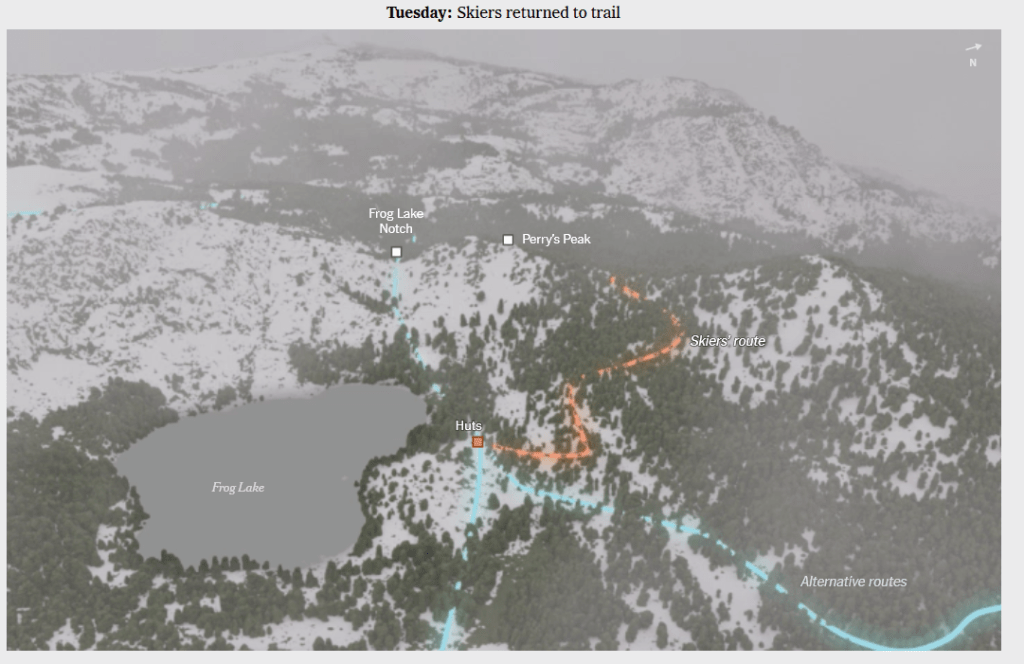
UPDATE: According to the New York Times Interview with survivors, the party took a whole other route as indicated below. This route took them directly under Perry’s Peak where the avalanche too place. (orange line) The regular route would have been Frog Lake Notch where they came in two days prior, but the guides decided not to use that route.

What we do know is what followed.

Search-and-rescue crews had to enter whiteout conditions and severe avalanche danger to reach the survivors. For hours, rescuers put their own lives on the line in terrain that was actively unstable. That’s what these teams do — but every risky decision in the backcountry ripples outward, placing others in harm’s way too.

This isn’t about pointing fingers. It’s about recognizing something deeply human.

We all feel the pull to keep going.
To finish what we started.
To not waste the opportunity.

But experience — real experience — teaches a quieter truth:

Turning back isn’t failure.
Waiting isn’t weakness.
Cancelling isn’t defeat.

Sometimes it’s:

The decision to stay in the hut and wait it out.
The willingness to cancel the trip altogether.

I think back to the summers of hiking to Frog Lake — the sunlight, the wildflowers, the sheer effort it took even in calm conditions — and this week’s loss feels even heavier.

Nine families are now living with the reality that the mountain will always be there…

…but their loved ones aren’t.

If there’s anything this tragedy leaves us with, it’s this:

The wilderness rewards skill and preparation.
But it demands humility.

And sometimes the most experienced thing we can do
is listen when the mountain says no.

Stay safe out there. The mountains are calling… but sometimes it’s best not to answer.

1000 Year Old Village Where Families Still Live!

Taos Pueblo is one of the oldest continuously inhabited communities in North America — and it is still home to families today.

This video is a quiet walk through the pueblo, observing its adobe architecture, San Geronimo Church, Red Willow Creek, and the Sangre de Cristo Mountains rising behind it.

Designated a UNESCO World Heritage Site, Taos Pueblo is a living community, not a museum. Traditions, ceremonies, and daily life continue here much as they have for over a thousand years.

Filmed respectfully and intentionally, this video is meant to be experienced slowly.

📍 Taos Pueblo, New Mexico

A ride in a Self-Driving Car! Would You?

In 2012, autonomous vehicle testing in California officially began. This was before I retired in 2014 as a media spokesperson for the California Department of Motor Vehicles (DMV). The Department was overseeing this entire thing in California! It was a fascinating time. Tech enthusiasts and skeptical onlookers alike were wondering if self-driving cars would ever become a reality. I didn’t realize those days at the DMV would come full circle in 2024. In 2024, I found myself riding in a Waymo through the bustling streets of San Francisco. I was very skeptical back then, but here we are!

Here’s the thing… Self Driving cars, Waymo have 29 cameras and 360 degree view. No blind spots like us humans who sit inside of our cars, having to crane our necks to see things. Humans are distracted, emotional, angry, tired, and sometimes under the influence while operating cars. Are self driving cars perfect? NO. They’ve had their issues, but as I see it, like all technology, they will get better with time and innovation. Moving from horse and buggy to automobiles wasn’t perfect either, but look at cars now! I think in 50 (maybe sooner?), these cars will be the norm.

Buckle your seat belt because self-driving big trucks are next!

Packing Up 25 Years of Ranch Life -Moving to New Mexico

And so it begins… the purging of a 25-year life on a 12-acre ranch. When we bought the place in 2000, we had two horses and a dream. That dream, like our herd, eventually grew—to four horses, one donkey, two sheep, five dogs, and a boatload of barn cats that kept mysteriously disappearing (cue Wile E. Coyote). We poured blood, sweat, and more money than we care to admit into home improvements, barns, fencing—only to find that they often needed repairing or replacing. It seemed to be a never-ending task, but every minute of country living was worth it. City life just wasn’t in our blood any longer, replaced instead by a mix of hay, dirt, rattlesnakes, and the occasional whiff of manure.

Fast forward 25 years, and with all the animals either having passed on or been re-homed (our beloved donkey and one horse are now living their best retirement lives on amazing ranches), it’s time to bid farewell to our rustic paradise and find a new adventure. We’ve decided that this new chapter will unfold in the northern part of New Mexico, likely between Albuquerque (took me a while to learn how to spell that) and Santa Fe. Our next home might have less fencing to mend and fewer barns to build, but it promises new memories.

As we pack up (and purge) our lives, we’ve discovered that humor is our best packing companion. Each item we box up brings a memory, a laugh, and many “Do I really need this” questions. The process is chaotic, but it’s also a reminder of all the joy, hard work, and love we’ve poured into a small slice of heaven in the windy grasslands. While we’re excited about our new adventure, we’ll carry a piece of this ranch—and all its quirks and joys—with us. Here’s to new beginnings. I hope to capture the process of all the stuff that has yet to be done to get this ranch on the market and all that entails! D-Day to market is December 1. We got this. (I think)

Leave a comment

Anchorage to Talkeetna! We did A Lot!

Hey all! This is Episode 2 of our epic Alaska Road trip. In this video, we travel from Anchorage to Talkeetna with stops at the breathtaking Hatcher Pass and the Independence Mine and then Wasilla where we visit the Iditarod Headquarters and take a ride with an actual Iditarod sled dog team! Oh yeah…. we got to see something that only 10% of summer visitors in Alaska get to see!!! We did a lot in one day! Come along for the ride!

Blazing a Trail in Big Snow!

The Sierra saw huge snows in December and the back Country is another world. Huge granite boulders and outcroppings that are impossible to traverse the summer. In the summer, the trail makes switchbacks around this rough terrain. In the winter, the terrain is transformed to rolling hills of snow high above the granite. This is a portion of the Pacific Crest Trail that is just south of I-80 near Boreal Ski Resort. We pretty much went way around where the PCT that sits under 15 feet of snow and forged our own path to an awesome overlook of Donner Lake. The hike was hard and very slow going through the thick powder, but it was worth it! Head over to my YOUTUBE CHANNEL and subscribe and don’t forget to hit the notification bell!

My 2022 Hiking Stats

With my heat related issues, I’ve had to scale down my summer hiking. In the summer months the sun is almost straight above at 9:00am! The temps are already climbing into the 80s and it’s not even noon. In the high country where it’s nothing but granite and lots of uphill, its HOT! So, that means I need to be at the trail head at sunrise which is 5:30am, and that means leaving my house at 4:00am! If that’s what I have to do to keep hiking in the summer, then so be it! I’ll also be doing more Kayaking!

Advantages of the early morning mountain hike: No people and more wildlife! Win Win!

***There were a few trails which I hadn’t done before which are highlighted.

Rebel is the only one who is willing to get up that early!